
Write a C program to find all roots of a quadratic equation using if else. How to find all roots of a quadratic equation using if else in C programming. Logic to find roots of quadratic equation in C programming.
Input
Input a: 8
Input b: -4
Input c: -2
Output
Root1: 0.80
Root2: -0.30
Required knowledge
Basic C programming, Relational operators, If else
Quadratic equation
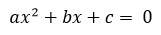
Wikipedia states, in elementary algebra a quadratic equation is an equation in the form of
Solving quadratic equation
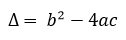
A quadratic equation can have either one or two distinct real or complex roots depending upon nature of discriminant of the equation. Where discriminant of the quadratic equation is given by
Depending upon the nature of the discriminant, formula for finding roots is be given as.
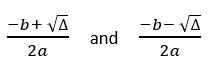
- Case 1: If discriminant is positive. Then there are two real distinct roots given by.

- Case 2: If discriminant is zero then, it has exactly one real root given by.


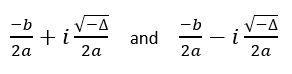
- Case 3: If discriminant is negative then, it has two distinct complex roots given by.

Logic to find all roots of a quadratic equation
Based on the above formula let us write step by step descriptive logic to find roots of a quadratic equation.
- Input coefficients of quadratic equation from user. Store it in some variable say a, b and c.
- Find discriminant of the given equation, using formula discriminant = (b*b) – (4*a*c).
- Compute roots based on the nature of discriminant.
- If
discriminant > 0then,
root1 = (-b + sqrt(discriminant)) / (2*a)and
root2 = (-b - sqrt(discriminant)) / (2*a).Learn – Program to find square root of a number using sqrt() function.
- If
discriminant == 0then,root1 = root2 = -b / (2*a). - Else if
discriminant < 0then, there are two distinct complex roots where
root1 = -b / (2*a)androot2 = -b / (2*a).Imaginary part of the root is given by
imaginary = sqrt(-discriminant) / (2*a).
After this much reading let us finally code the solution of this program.
Program to find roots of quadratic equation
/**
 * C program to find all roots of a quadratic equation
 */

#include <stdio.h>
#include <math.h> /* Used for sqrt() */

int main()
{
    float a, b, c;
    float root1, root2, imaginary;
    float discriminant;

    printf("Enter values of a, b, c of quadratic equation (aX^2 + bX + c): ");
    scanf("%f%f%f", &a, &b, &c);

    /* Find discriminant of the equation */
    discriminant = (b * b) - (4 * a * c);


    /* Find the nature of discriminant */
    if(discriminant > 0)
    {
        root1 = (-b + sqrt(discriminant)) / (2*a);
        root2 = (-b - sqrt(discriminant)) / (2*a);

        printf("Two distinct and real roots exists: %.2f and %.2f", root1, root2);
    }
    else if(discriminant == 0)
    {
        root1 = root2 = -b / (2 * a);

        printf("Two equal and real roots exists: %.2f and %.2f", root1, root2);
    }
    else if(discriminant < 0)
    {
        root1 = root2 = -b / (2 * a);
        imaginary = sqrt(-discriminant) / (2 * a);

        printf("Two distinct complex roots exists: %.2f + i%.2f and %.2f - i%.2f",
                root1, imaginary, root2, imaginary);
    }

    return 0;
}
Before you move on to next exercise. It is recommended to learn this program using another approach using switch...case.
Learn more – Program to find roots of quadratic equation using switch case.
Output
Enter values of a, b, c of quadratic equation (aX^2 + bX + c): 8 -4 -2
Two distinct and real roots exists: 0.81 and -0.31
Happy coding 😉
Recommended posts
- If else programming exercises index.
- C program to check whether a triangle is valid or not if all angles are given.
- C program to check whether a triangle is valid or not if sides are given.
- C program to find percentage and grade.
- C program to calculate gross salary of an employee.
- C program to calculate gross electricity bill.
- C program to find power of a number.