
Imagine a linked list like a treasure hunt: each clue (node) holds a prize (data) and directions to the next clue (pointer). Unlike arrays that need contiguous memory, linked lists dynamically chain nodes anywhere in memory. Perfect for unpredictable data growth! To understand more we will begin our learning how to create and traverse linked list?
💡 Key Insight: Use linked lists when you need frequent insertions/deletions or don’t know data size upfront.
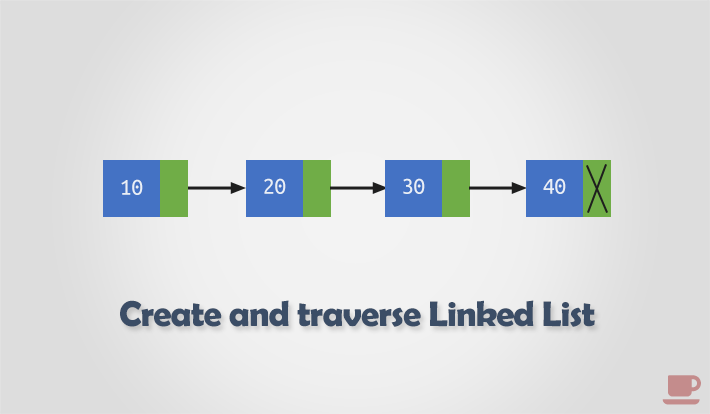
Step 1: Define the Node Structure
typedef struct node
{
    int data;           // Stores integer value, can be char, struct etc.
    struct node* next;  // Pointer to next node
} node;
🤔 Why use typedef in C? It simplifies code (use node instead of struct node).
Step 2: Create Node Dynamically
- Allocate new memory using
malloc(), pass size in bytes to allocate as argument. Get the size of our node usingsizeof(node). - Typecast the
malloc()result to the pointer tonode. malloc(), returnsNULLon failure. Verify for successful memory allocation.- Assign
dataand pointer tonextnode.
node* createNode(int data)
{
    // Allocate memory for new node
    node* newNode = (node*) malloc(sizeof(node));

    if (newNode == NULL)
    {
        // Memory allocation failed, exit program
        printf("Memory allocation failed!");
        exit(1);
    }

    // Initialise node data and pointer
    newNode->data = data;
    newNode->next = NULL;

    return newNode;
}
⚠️ Critical Check: Always verify malloc() success, during dynamic memory allocation! Always initialise a pointer to NULL to avoid dangling pointers.
Step 3: Build the Linked List
node* head = NULL;  // Start with empty list

// Create nodes
node* node1 = createNode(10);
node* node2 = createNode(20);
node* node3 = createNode(30);
node* node4 = createNode(40);

// Link nodes: 10 → 20 → 30 → 40
head = node1;
node1->next = node2;
node2->next = node3;
node3->next = node4;
Step 4: Traverse the List (Iterative)
Traversal Logic:
- Start at
headnode. - Print
data, move tonextnode. - Stop at
NULL(end of list).
void traverseList(node* head)
{
    node* current = head;  // Start from head
    while (current != NULL)
    {
        printf("%d → ", current->data);
        current = current->next;  // Move to next node
    }
    printf("\n");
}

// Output: 10 → 20 → 30 → 40 → NULL
Memory Management Best Practices
- Free Memory: When allocating memory dynamically, always clean the allocated memory before exiting. Use
free()function to clear memory on demand. - Avoid Leaks: Call
freeList(head)before program exit.
C Program to Create and Traverse Singly Linked List
/**
 * C program to create and traverse a Linked List
 */

#include <stdio.h>
#include <stdlib.h>

/* Structure of a node */
typedef struct node
{
	int data;           // Stores integer value, can be char, struct etc.
	struct node* next;  // Pointer to next node
} node;


// Functions to create, traverse and display list
node* createNode(int data);
node* createList(int nodeCount);
void traverseList(node* head);
void freeList(node* head);

int main()
{
	int totalNode;
	node *head;

	printf("Enter the total number of nodes: ");
	scanf("%d", &totalNode);

	head = createList(totalNode);

	printf("\nData in the list \n");
	traverseList(head);

	freeList(head);

	return 0;
}

/**
 * Creates a new node with the given data and returns the pointer to the node.
 */
node* createNode(int data)
{
	// Allocate memory for new node
	node* newNode = (node*) malloc(sizeof(node));

	if (newNode == NULL)
	{
		// Memory allocation failed, exit program
		printf("Memory allocation failed!");
		exit(1);
	}

	// Initialise node data and pointer
	newNode->data = data;
	newNode->next = NULL;

	return newNode;
}

/**
 * Create a list of nodes. Returns the pointer to head node.
 */
node* createList(int nodeCount)
{
	node *head = NULL, *newNode = NULL, *prevNode = NULL;
	int data, counter;

	// No new node to create
	if (nodeCount <= 0)
	{
		printf("No nodes to create");
		return head;
	}

	for (counter = 1; counter <= nodeCount; counter++)
	{
		// Read data in the node from user
		printf("Input data at node %d: ", counter);
		scanf("%d", &data);

		// Create a new node
		newNode = createNode(data);

		if (prevNode != NULL)
		{
			// Link previous node with newNode
			prevNode->next = newNode;
		}

		// For next iteration make current node as previous node
		prevNode = newNode;

		// Ensure head points to the first node in the list
		if (counter == 1)
		{
			head = newNode;
		}
	}

	return head;
}


/**
 * Traverses through entire linked list and prints data to console.
 */
void traverseList(node* head)
{
	node* current = head;   // Start from head
	while (current != NULL)
	{
		printf("%d -> ", current->data);  // Print data of current node
		current = current->next;  // Move to next node
	}
	printf("\n");
}

/**
 * Traverses from head till NULL, deletes all the allocated bytes.
 */
void freeList(node* head)
{
    printf("Clearing memory!");

    node* current;
    while (head != NULL)
    {
        current = head;

        // Move head to next node
        head = head->next;

        // Clear the current node
        free(current);
    }
}Enter the total number of nodes: 4
Input data at node 1: 10
Input data at node 2: 20
Input data at node 3: 30
Input data at node 4: 40
Data in the list
10 -> 20 -> 30 -> 40 ->
Clearing memory!
Recursive Traversal (Advanced Technique)
You can also use recursive approach to traverse linked list. Below is a code sample.
void recursiveTraverse(node* head) {
    // Base case: end of list
    if (head == NULL) {
        return;
    }

    // Print current node data
    printf("%d → ", head->data);

    // Recursive call for next node
    recursiveTraverse(head->next);
}
🚀 Performance Note: Recursive traversal uses O(n) stack space, while iterative uses O(1) space.
Iterative traversal vs Recursive traversal
| Aspect | Iterative Approach | Recursive Approach |
|---|---|---|
| Space Complexity | O(1) – Constant space | O(n) – Call stack overhead |
| Performance | Faster execution | Slower due to function calls |
| Memory Safety | No stack overflow risk | Stack overflow for large lists |
| Code Style | More explicit, longer | Concise and elegant |
| Use case | Large datasets | Small lists |